
Berkshire Projected and Actual Release
Massachusetts uses several date terms. A sentence-based Release Date starts from the terms imposed without deductions later earned. The Earliest Release Date reflects the earliest eligibility point, including parole eligibility and deductions that may be earned. For DOC administration, a projected discharge date adjusts the maximum discharge date by applicable deductions and current sentence structure. The actual release date records the event after credits, orders, warrants, detainers, parole action, and processing are resolved.
A forecast is conditional. It can help plan for a likely date, but it is not proof that a person left. The signed Certificate of Discharge/Release or the custodian’s final entry is stronger. A pretrial person has no such sentence-expiration forecast at all. Bail, recognizance, future court action, or a new commitment controls that path.
Find Berkshire Inmate Release Dates
Start with the last known custodian. A sentence served wholly at Berkshire County House of Correction is a BCSO record, not an MA DOC record. A state-prison commitment belongs to the Massachusetts Department of Correction. The public Massachusetts locator routes current state custody through VINELink, but no official source promises that its result displays a projected discharge field or persists after release.
- Confirm whether the person is pretrial, serving a Berkshire HOC sentence, or serving an MA DOC sentence.
- Read the exact sentencing docket for the term, jail-credit order, concurrent or consecutive structure, and later amendments.
- For a Berkshire sentence, request the jail-management release calculation, sentence length, jail credit, earned time, and actual discharge entry from BCSO.
- For state prison, use the official MA DOC custody route, then request the Inmate Sentence Listing and Deduction from Sentence report when the projected field is not public.
- Ask for the signed Certificate of Discharge/Release after the event to confirm date, release type, and destination.
The Berkshire County release search and record path supplies the county contacts and transfer checks. If the person moved from Berkshire to DOC, the BCSO entry marks the end of county custody, while DOC calculates the later state release.
Berkshire Earned-Time Release Rules
M.G.L. c. 127, § 129D authorizes earned deductions for satisfactory participation in qualifying programs or activities. A state-prison sentence may receive up to 7.5 days for each qualifying activity per month, capped at 15 days monthly. A house-of-correction sentence may receive up to five days per activity per month, capped at ten days monthly. Successful completion can add credit within statutory limits.
The distinction matters in Berkshire County. A sentence at the county HOC uses the ten-day monthly cap, not the state-prison cap. Completion credit for an HOC program requires at least six months of satisfactory participation. Across the framework, total deductions and credits cannot reduce the imposed maximum, or the parole minimum, by more than 35 percent. The individual calculation still depends on offense date, sentence form, eligibility, participation, and any forfeiture.
The official earned-time statute provides the controlling caps.
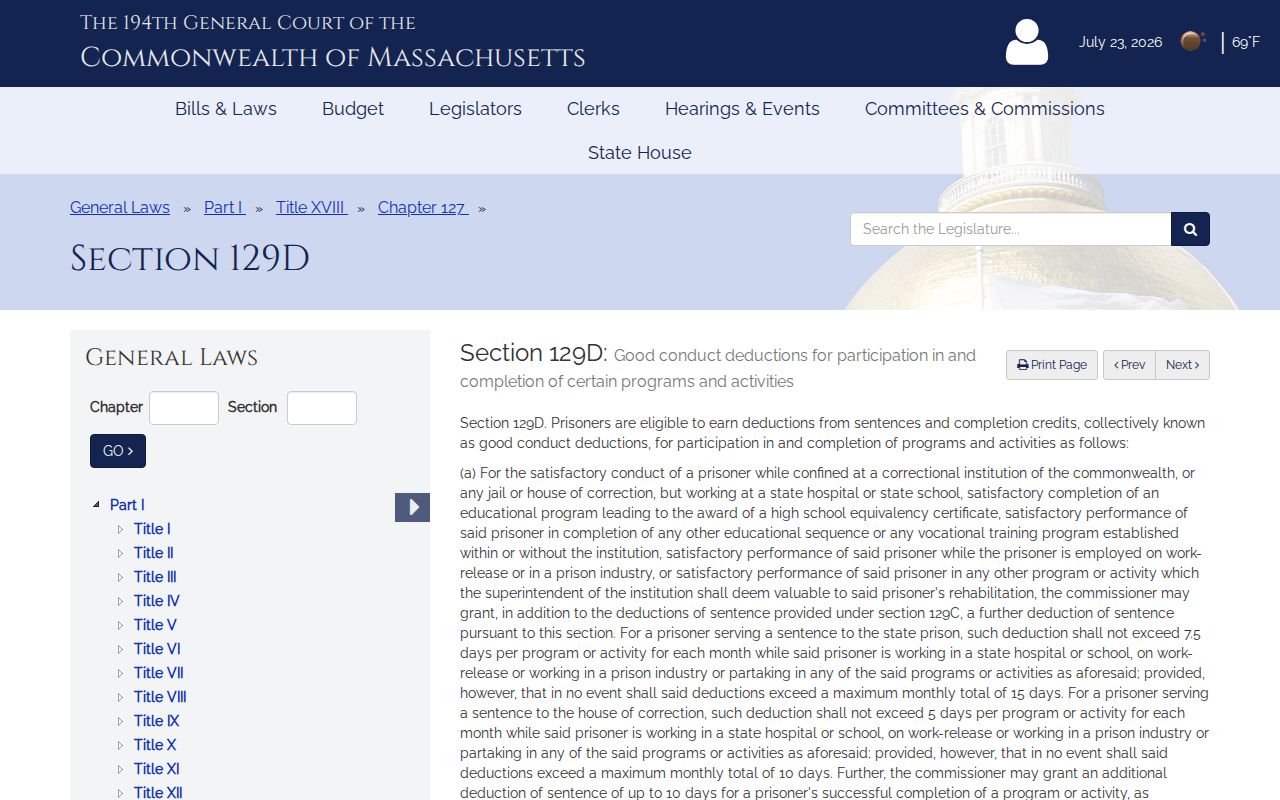
The statute confirms why a county HOC estimate cannot simply copy a state-prison calculation.
Why Berkshire Release Dates Change
A projection reflects the record available at that moment. Massachusetts DOC’s Central Date Computation Unit structures state sentences, enters the calculation, checks it manually, and corrects the system when needed. BCSO and the sentencing court hold the analogous county-sentence facts. A new document or event can move the result.
| Change | Effect on the release date |
|---|---|
| Corrected mittimus or court order | Changes the legal sentence or commitment basis |
| Pretrial jail-credit order | Adds or corrects time credited against the sentence |
| Concurrent or consecutive sentence | Restructures how multiple terms run |
| Earned credit, forfeiture, or restoration | Moves deductions within governing limits |
| Parole action | Can create community supervision or delay the expected route |
| Warrant, detainer, or outside sentence | May block community departure or send the person to another custodian |
| Manual computation correction | Fixes a system result that did not reflect the lawful structure |
A detainer is a request or notice that another authority may take custody. It can mean the person leaves the current institution on the projected date yet does not enter the community. Always request destination along with the actual date.
Confirm Berkshire Release Completion
For present MA DOC custody, the official Massachusetts page routes a full name or commitment number to VINELink and a telephone option at 866-277-7477. VINE may send a custody-change alert, but it covers MA DOC only. It does not cover Berkshire County Jail and House of Correction or municipal police lockups. The VINELink Release Check explains that narrow state route.
For a state discharge, request the signed certificate, coded release type, destination, sentence listing, and relevant deduction report from the DOC Records Access Officer at doc.rao@state.ma.us or 508-422-3436. For a Berkshire HOC release, ask BCSO Records Access Officer Daniel Sheridan for the county calculation and discharge record. The court docket can corroborate the sentence and later order, but it does not timestamp the person’s physical exit.
Note: A favorable parole decision authorizes a possible route; the custodian’s final entry establishes the actual departure date and destination.
Massachusetts Discharge Computation Records
For state sentences, the DOC Central Date Computation Unit carries out the judgment, structures terms, computes release dates, and records them in the Inmate Management System. The Inmate Sentence Listing displays sentence and date computation. The Deduction from Sentence report itemizes recommended earned credit and updated combined dates. Under 103 CMR 410, the unit also prepares lists of people expected to release within 150 days and processes Certificates of Discharge/Release before physical discharge.
Under 103 CMR 411, staff submit the projected discharge date at least 60 days beforehand. The final month’s projected participation credit is limited by the regulation and applied only after satisfactory participation is confirmed. These internal lead times do not create a public countdown. Request the records when the public locator does not show enough detail.
The sentence listing and deduction report answer different questions. The listing shows how the court’s terms were structured and which dates result. The deduction report traces credits recommended or applied over time. The later certificate and physical release entry show the event that occurred. Requesting all three avoids treating an early forecast as the final Berkshire County inmate release date.
For a county HOC term, make the parallel request to BCSO rather than DOC. Berkshire’s Chapter 126 filings demonstrate that the sheriff records booking date, release date, earned time, sentence length, and jail credit. The public quarterly file is delayed and omits names, but it supports asking for those fields in the identified person’s underlying record.
- Mittimus
- The official court paper that commits or releases a person.
- Projected discharge date
- A conditional sentence calculation using current deductions and structure.
- Actual release
- The completed event recorded by the custodian.
- Detainer
- A notice that another authority may claim custody.
Berkshire Release and 85 Percent
The familiar “85 percent” phrase is not a Massachusetts calculator. The 1993 Truth in Sentencing Act changed the former statutory-good-time structure for many offenses committed after June 30, 1994. An official 2005 study found that people in its 2002 post-law release cohort served at least 85 percent of their sentences. That was a result for a historical cohort, not a statute directing every current sentence to be multiplied by 85 percent.
Mandatory minimums, habitual-offender provisions, offense dates, concurrent or consecutive terms, jail credit, earned deductions, forfeitures, amendments, parole law, and outside holds can all change an individual result. Some offenses restrict parole or deductions until a minimum is served. The exact judgment and governing statutes must control, not a percentage estimate.
Pretrial confinement credit is another reason a shortcut fails. M.G.L. c. 279, § 33A directs the sentencing court to credit qualifying time confined before sentence while awaiting and during trial against a later jail, HOC, or state-prison term. The court orders that credit. A records clerk then applies the lawful order within the sentence structure. An estimate based only on the sentencing date can miss credited time or wrongly assume credit that was never ordered.
Parole eligibility is distinct from sentence expiration. Eligibility marks when the Parole Board may consider release under governing law. It does not guarantee a favorable decision or physical release that day. A positive vote can still be followed by approval steps, rescission, another sentence, an outside hold, or a non-community destination.
Berkshire Weekend Discharge Rule
Massachusetts has a concrete calendar rule for an expiring sentence. M.G.L. c. 127, § 150 provides that when the term ends on a Saturday, Sunday, or legal holiday, discharge occurs on the preceding day. It does not create a general early-release right for bail, court orders, or parole, and it does not defeat an outside warrant or detainer.
The official weekend and holiday statute states the rule.
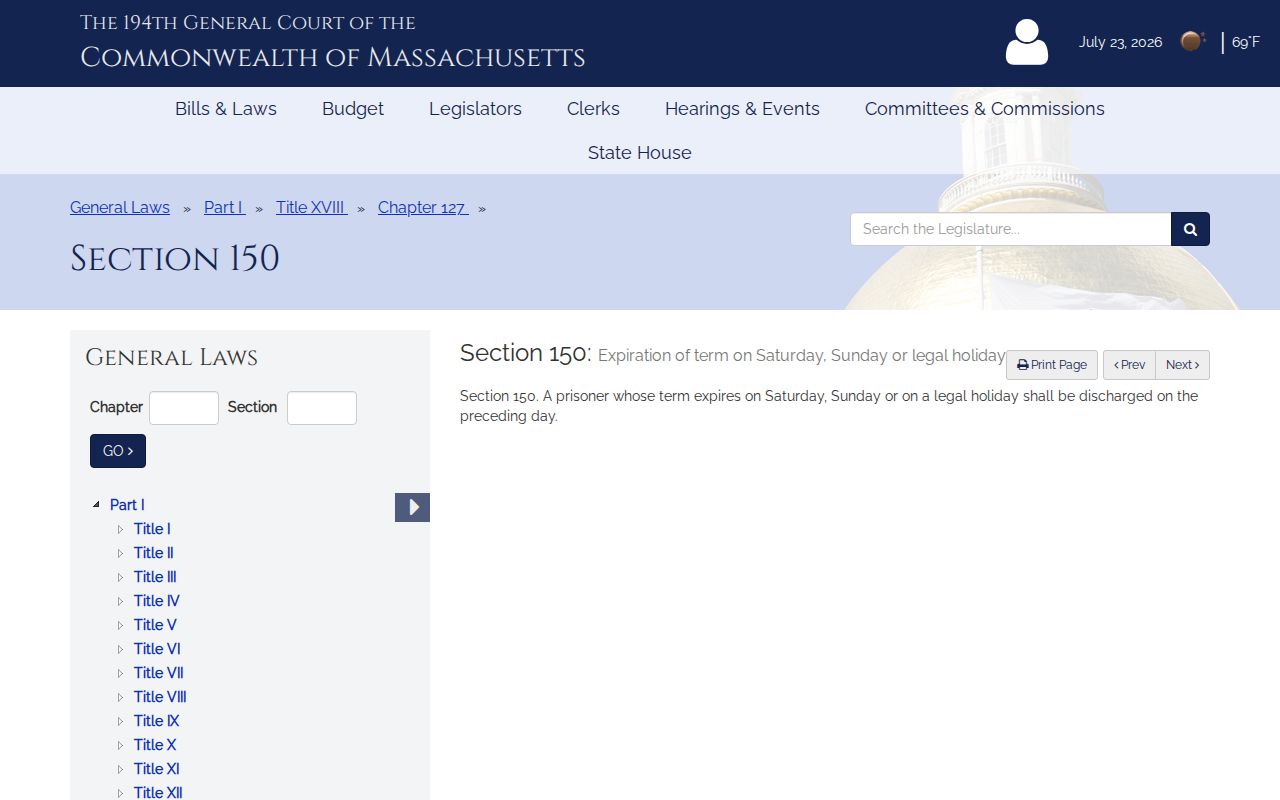
The provision explains one lawful shift in a sentence-expiration date, but the final record must still be checked for the actual event.
Berkshire Intermittent Sentence Dates
A separate statute, M.G.L. c. 279, § 6A, permits a court to order some qualifying first-offense HOC sentences of no more than one year to be served on weekends or other intervals. The default statutory pattern describes Friday evening reporting and Monday morning release, or Tuesday when Monday is a holiday, until the full term is served.
Each weekly departure is not final sentence completion. The docket and sheriff record should show the intermittent structure and the true end of the term. Treating every Monday departure as a final release would misstate both custody and sentence status.
A release estimate should therefore record its source and calculation date. Later credit, court, parole, or custody changes can make an older estimate stale even when it was accurate when issued. The final Berkshire record remains the actual discharge entry and destination.